Feel like Andara
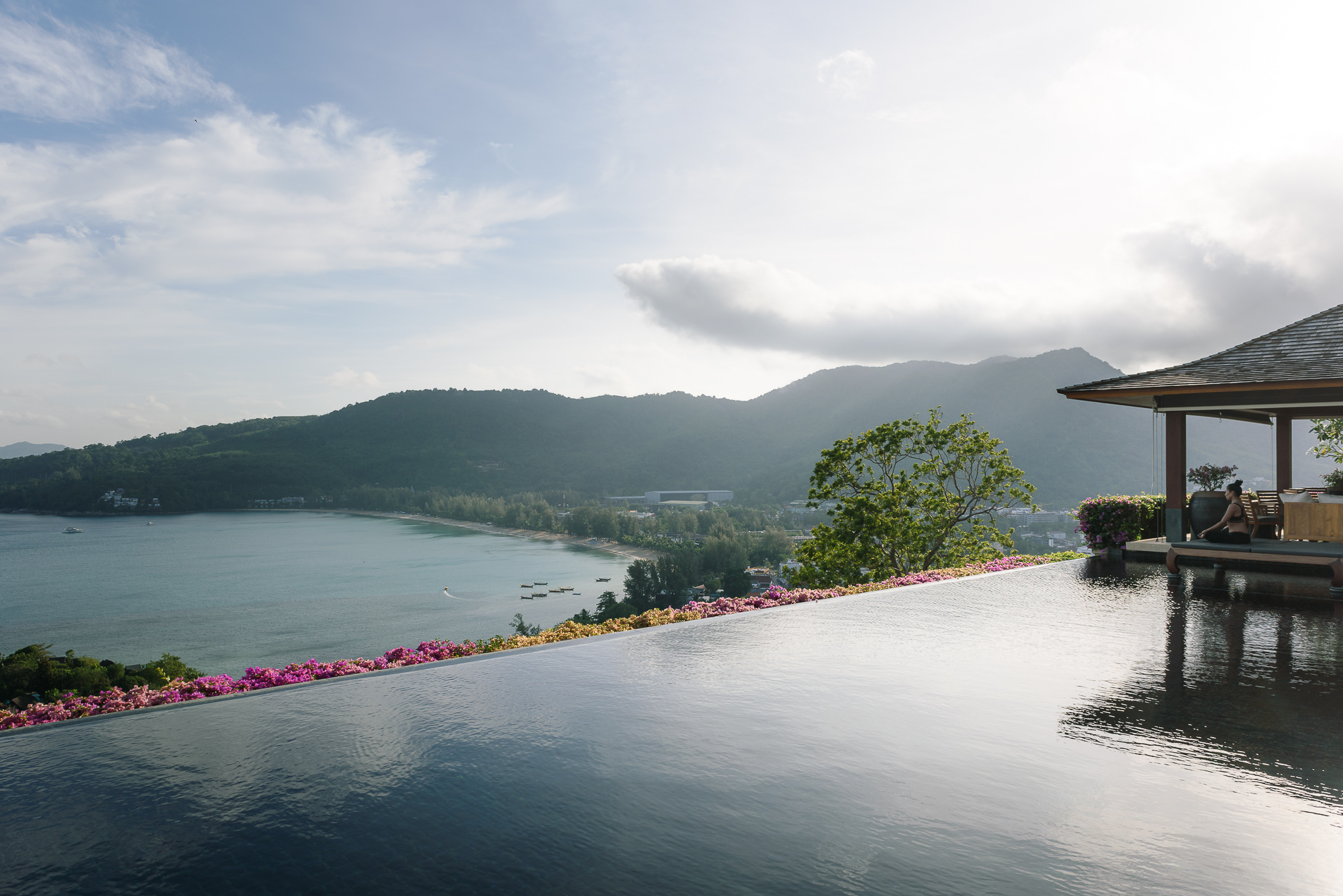
Real photography, restrained typography and generous space. Accommodation and booking decisions stay clear throughout the experience.
Vision, evidence, delivery and investment.
Read the proposalPrepared by Rex · October 2026 · Private reviewAndara has the setting, the spaces and the photography to make a remarkable first impression. The opportunity is to give them a considered digital experience, then make it easy for a guest to choose a stay and for marketing to launch the next campaign.
Real photography, restrained typography and generous space. Accommodation and booking decisions stay clear throughout the experience.
Bring bedroom configuration, occupancy, floor area, pool type, approved inclusions, photographs and supplied plans together. Make accommodation comparison easy to find.
Approved templates and reusable sections let the team build offers, events and landing pages, update imagery and translations, and manage routine SEO without code.
SynXis stays at the heart of room reservations. Shopify is the proposed public marketing platform, subject to confirming content, language and editor needs. A platform change alone does not solve publishing or content quality; the workflow, governance and training must do that.
54 deduplicated findings distinguish observed defects, design opportunities and checks requiring owner access. Priorities guide the rebuild; they do not estimate lost revenue.
The desktop review captured an event promotion and consent panel together. The new design coordinates overlays and places promotions in context.
The homepage “Discover More” link carried 15–16 January 2026 dates at the October review. Great Savings carried May 2023 dates. Primary Book Now links used the normal property handoff; not every booking link is broken.
The destination map displayed an error and development watermark. Some displayed email addresses differed from their destinations. Content and language metadata contained errors.
The desktop pass covered 12 public pages at 1180×757 CSS pixels, plus public source and technical checks. No authenticated CMS, analytics, Search Console, hosting or booking administration was inspected. No live booking or enquiry was submitted. Runtime mobile, assistive technology, form delivery and end-to-end booking measurement remain validation tasks. No valid current Lighthouse or field Core Web Vitals score was obtained.
Useful foundations remain: reachable pages and sitemap index, self-canonicals and descriptions, multilingual content, comparison entry, SynXis links and existing measurement configuration to retain or validate.
Read the detailed audit · 54 findings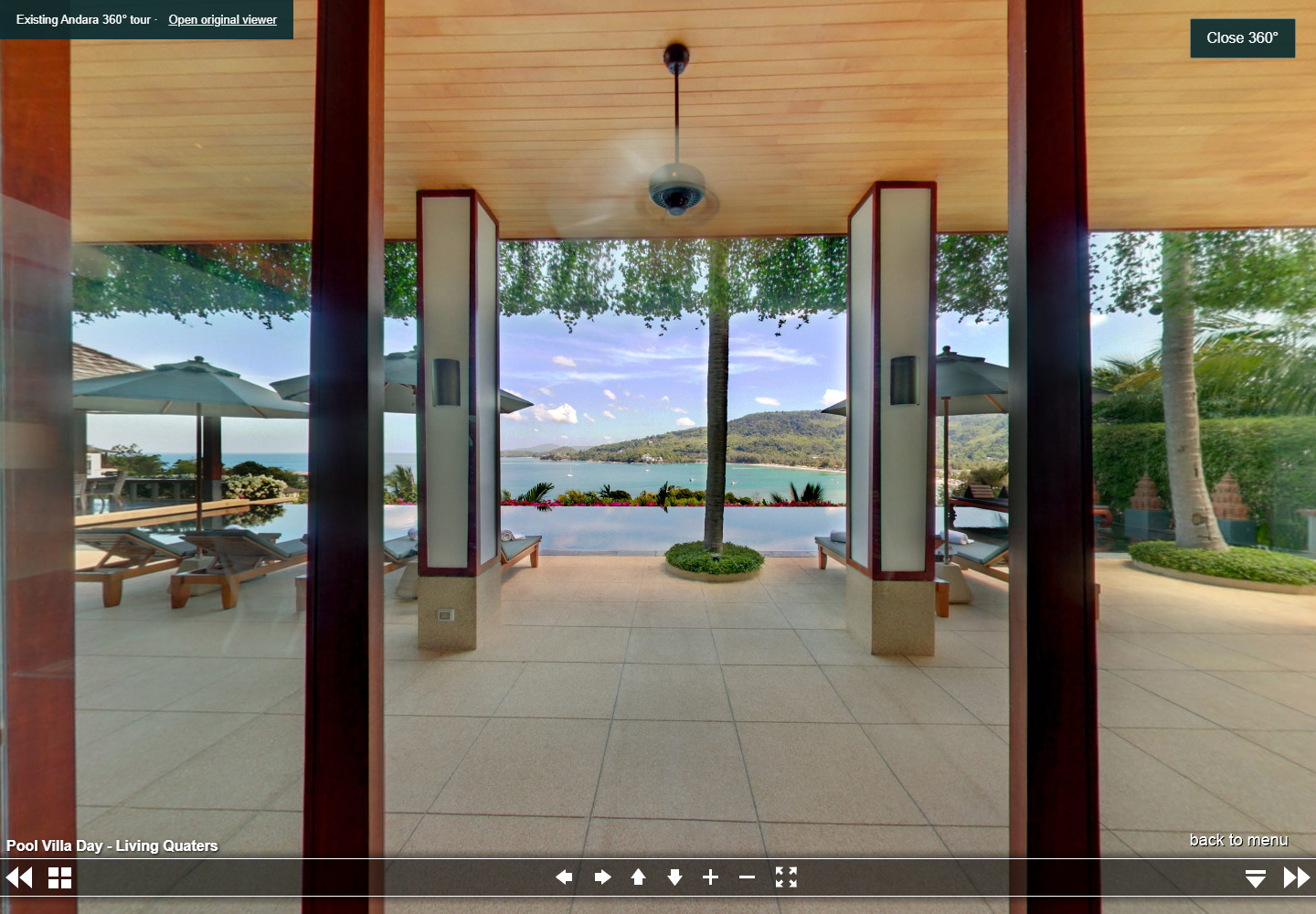
A full-bleed property introduction and clear primary action. Use real imagery with intentional desktop and mobile focal points, readable copy and a static alternative.
Consistent suite and villa pages bring room facts, gallery, approved floor plan, inclusions and comparison close to the decision. Names align with SynXis.
The cinematic concept moves from cloud cover and an aerial approach into staged villa assembly, the living room, pool and sunset. It establishes a proposal direction rather than surveyed room geometry. A separate photograph explorer offers source-backed resort destinations.
Proposal visualization: the camera path and structural assembly are illustrative and anchored to supplied and official photographs. Architecture, room identity and continuity remain unverified. It is not an as-built model or surveyed route. Andara’s existing 360 assets inform source research; their viewer is not embedded.
View the current cinematic conceptTimely offers, substantiated direct-booking benefits, arrival and location reassurance, followed by consistent booking or enquiry actions.
Kamala Beach is off property. The official source describes walking or complimentary transport from 9am to 6pm; exact routes and current operations need approval. Signature Villas is a separate estate and must remain distinct. A navigation choice never implies a measured path.
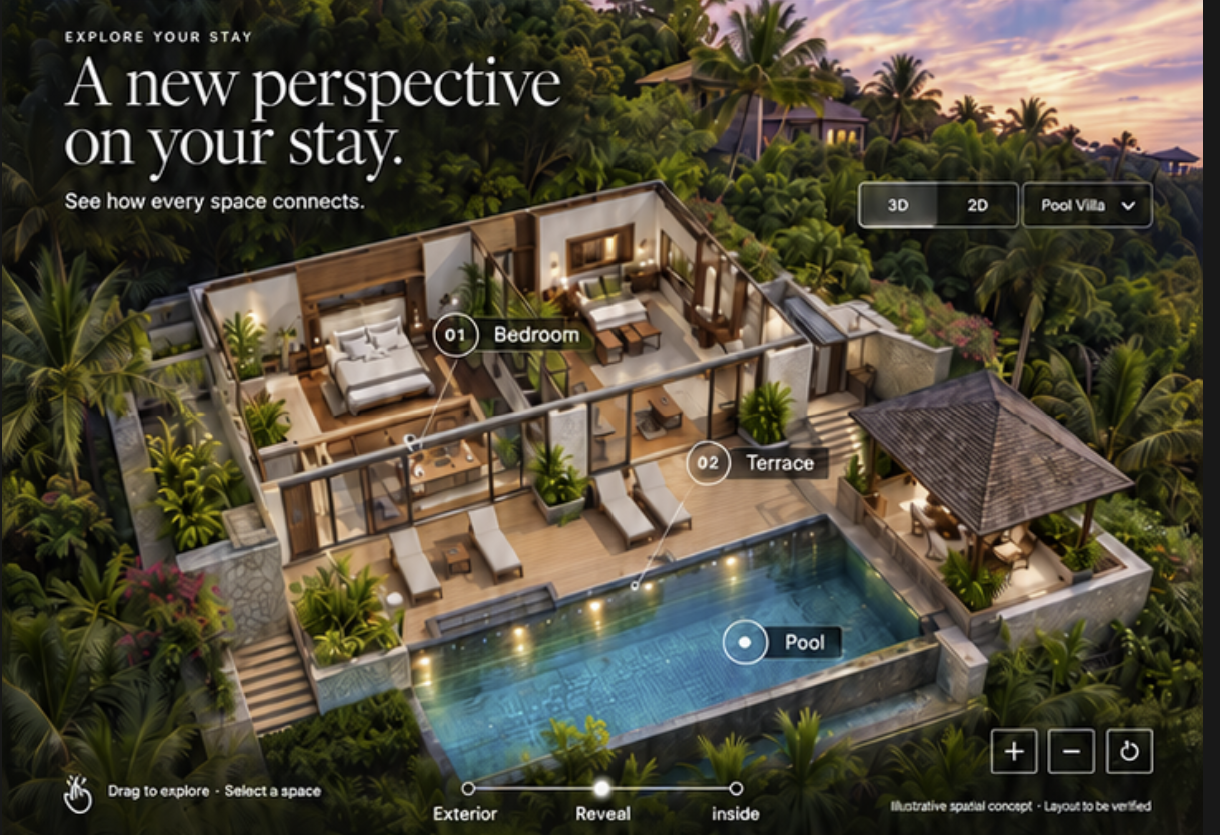
Use the scroll-driven journey to show the direction: clouds, aerial approach, staged villa assembly, living spaces, pool and sunset. Matched camera transitions create a connected-looking experience; the architecture and route remain illustrative until verified with Andara.
View the current conceptOpen the scroll-controlled filmCurrent scroll film: a 46.3-second camera-led journey through six chapters, delivered at 1600 × 900 for the web. The camera route and staged assembly are illustrative. Open the current homepage journey above to view it.
Mobile is a complete experience: portrait crops, comfortable targets, readable content, permitted zoom and menus, consent and booking controls tested together. The proposed cinematic direction uses gentle scroll transitions with reduced-motion support. Bespoke capture, motion and faithful additional tour production require separate agreed scope.
Introduce the resort and booking action; help guests compare suites and villas; bring distinctive experiences and timely offers into view; substantiate reasons to book direct; then give practical location, arrival and contact reassurance. Approve facts, inclusions, policies and guest proof with Andara before publication.
Creative approval covers the homepage, one accommodation detail page and the image-based resort journey at desktop and mobile sizes. Matched floor plans and exact villa identities remain asset gaps, so unverified bedrooms and geometry are never presented as the actual room.
Offer, event and landing-page templates with hero, text, galleries, inclusions, terms, enquiry and booking sections. Reorder approved sections and choose bounded layout variants with page-specific content.
Change images and copy with crop, focal point, size and alt-text guidance. Assign translation ownership and preview every launch language.
Manage titles, descriptions, URLs and meaningful image text. Review mobile and desktop previews, links and expiry before publication; redirects accompany agreed URL changes.
Acceptance means a nominated Andara editor creates a campaign, arranges sections, updates a second language and SEO, previews and publishes it without developer assistance.
They also create two approved layout variants without changing other pages, retire an expired offer and restore a previous version. New component types and custom integrations remain separately scoped development work.
These are interpretations of the brief. Each workflow has a practical acceptance test.
Likely concern: Routine campaigns may be waiting on outside help or taking too much effort to assemble.
Proposed solution: Provide distinct, reusable campaign, offer and event templates with approved hero, text, gallery, inclusions, terms, enquiry and booking sections. Use page-specific content so editing one campaign does not unintentionally change another.
Acceptance test: A marketing editor creates a new Festive page from an approved template, changes section order, adds approved content, previews it at desktop and mobile sizes and publishes it without code or developer assistance.
Likely concern: The team needs flexibility while keeping quality and consistency.
Proposed solution: Expose useful layout choices inside approved components: image position, section order, text alignment and appropriate content variants. Set sensible typography, spacing and crop defaults. Demonstrate how shared templates differ from page-specific content.
Acceptance test: The editor makes two approved layout variants and restores the selected version. Other pages remain unchanged. A genuinely new component is clearly identified as a separately scoped development request.
Likely concern: Small changes should not become support tickets or leave languages inconsistent.
Proposed solution: Create an image and content handbook covering focal points, size guidance, alt text and translation ownership. Agree a translation workflow and preview checklist for every launch language.
Acceptance test: The editor replaces a hero image and room description, updates an agreed secondary language, previews both and corrects a crop without developer help.
Likely concern: Campaigns need usable titles, descriptions, URLs and image descriptions without technical intervention.
Proposed solution: Make routine SEO fields part of the publishing workflow, with naming rules and redirect guidance for URL changes. Audit canonical URLs, language tags, social previews and migration redirects centrally.
Acceptance test: The editor changes a test page title, description, URL and meaningful image alt text. The rendered output is checked and the old URL resolves through the agreed redirect.
Public pages, imagery, approved templates, campaigns, standard forms and routine publishing/SEO.
Availability, rates, reservation rules, room bookings, payments and existing booking operations.
Observed primary header and sampled suite actions used be.synxis.com/?Hotel=27746. The baseline retains this property handoff; dates and guest details remain inside the engine. A date-and-guest bar, room or offer preselection is optional and needs supported parameter mapping and tests. Room inventory APIs, reservation migration and a replacement checkout are outside the baseline.
Agree a named integration register for forms, destinations, fields, owners and subscriptions. Test permitted enquiries, confirmation and failure states. Additional CRM, complex forms, APIs and non-room commerce need a concrete brief and cost approval. Non-room carts do not replace SynXis reservations.
Likely concern: The redesign must support current reservation operations and avoid introducing a second roombooking system.
Proposed solution: Provide a reusable SynXis booking action on every relevant template, with an agreed property link as the default. Validate any optional offer, room, date, language or occupancy mapping with Andara and its SynXis contact.
Acceptance test: Every launch booking CTA opens the correct property. A test matrix checks header, accommodation, offer and campaign entry points. Unsupported preselection is omitted rather than silently promised.
Likely concern: The team needs to know which campaigns produce useful enquiries and bookings.
Proposed solution: Inventory existing tags and account ownership; define an event dictionary; implement consentaware tracking; test events and attribution. Plan cross-domain measurement with the SynXis administrator and validate what the engine can expose.
Acceptance test: Controlled tests verify events once, with the intended parameters and consent state. Booking revenue and confirmation events are validated only through an approved test mechanism and reconciled to the booking source.
Likely concern: New campaign ideas should not become open-ended custom integration projects.
Proposed solution: Agree a named integration register listing each form, destination, data field, owner and subscription. Build agreed standard forms and validate routing and failure states. Assess each additional service before implementation.
Acceptance test: A permitted test enquiry reaches the correct team, produces clear confirmation and does not leak personal data into analytics. The team can identify who owns each integration and its recurring fee.
Likely concern: The team may want to sell extras or campaign products in future without another rebuild.
Proposed solution: Treat non-room commerce as an optional workstream with defined products, fulfilment, payment provider, tax/refund rules and regional availability. Keep it separate from SynXis room reservations.
Acceptance test: Before quoting implementation, approve a concrete purchase flow and operating owner. Test checkout, fulfilment and refunds in a safe environment. A generic cart request is not treated as a complete commerce specification.
The dated audit identified WordPress, Divi and WPML assets. The proposed Shopify marketing site needs a fit check for pages, languages, individual editor roles and permissions, URL conventions and migration. Select a plan against the current terms, billing region and actual team requirements; no plan purchase is made by this prototype.
Baseline reservation continuity is the proposed SynXis property handoff. Optional preselection needs tests for dates, adults, children and ages, room names, language, unavailable inventory and campaign conditions. Unsupported parameters fall back to the documented property link.
Client-reported brand.com booking share.
Clarify period, denominator and cancellation treatment.
This is not a verified website conversion rate.
Measure accommodation engagement, offers, booking-engine handoffs and qualified enquiries. Where SynXis supports approved instrumentation, reconcile completed transactions, value and currency to the booking source. A handoff click is never reported as a confirmed booking.
Inventory GA4, GTM and Meta ownership, define an event dictionary, test consent states and duplicate firing, and validate cross-domain attribution with the SynXis administrator. Compare like-for-like periods, accounting for traffic mix, rates, availability, seasonality and campaigns. Improvement is a goal, not a guaranteed uplift.
Agree repeatable lab performance checks and field measurement when traffic permits. Proposed field targets are good Core Web Vitals thresholds at the 75th percentile: LCP ≤2.5 seconds, INP ≤200 milliseconds and CLS ≤0.1. These are targets, not current measured results or unconditional guarantees.
Agree whether direct share means bookings, room nights or revenue; use the same reporting period and cancellation treatment. Website conversion uses completed website bookings divided by agreed eligible website sessions, with consent and attribution gaps documented.
Where data supports it, review net booking revenue, average booking value, cancellations and acquisition cost alongside engagement, booking starts and qualified enquiries by device, market and campaign.
Validate data quality first, compare equivalent periods, then test accommodation comparison, offer placement and booking reassurance one at a time where sample size allows. Rates, inventory, demand and channel strategy also influence outcomes.
The original public PageSpeed request returned a quota error. No current Lighthouse score or field result is claimed.

Training, platform subscriptions, extra migration, additional languages or translation services, new component types, extra revision rounds, photography/video, bespoke capture or additional tour production, custom APIs, CRM, commerce and booking-preselection enhancements are separate. No new production charge or inclusion is assumed by this proposal demonstration.
Confirm pages, languages, editor roles, integrations, campaign priorities, baseline and tour sources. Approve sitemap, content plan, rights, responsibilities and statement of work.
Review homepage, accommodation page and image-based cinematic journey on desktop and mobile before extending the design system.
Build templates, sections and approved experience; migrate content and demonstrate page-specific editing with marketing.
Booking and marketing owners verify SynXis, forms, analytics and consent against the integration register.
Complete device, accessibility, content, tour accuracy, redirect and recovery checks. Deliver handbook and launch plan. Record remaining blockers for approval.
Publish only after Andara approval, then verify key journeys and transfer documentation and named access. Follow with agreed team training and separately agreed support.
Dates follow confirmed scope, access, content readiness, languages and review owners. This is a proposed sequence, not a committed launch date.
Correct booking property and supported parameters; usable forms and error states; room and offer facts approved; tour identities and geography signed off. Use an approved non-chargeable test path rather than live reservations for QA.
Agreed real devices and desktop browsers; touch, keyboard, visible focus, zoom, contrast, reduced motion, fallback imagery, menus and consent together. Reproducible speed evidence and documented limitations.
Independent editor campaign task, all launch languages proofread, expired offers retired; redirects, canonicals, indexability, language tags, sitemaps and social previews validated.
Validate event receipt across consent states, no duplicate conversions and no personal data in analytics. Hand over named accounts, commissioned source, content and integration guides, support contacts, cost register and tested recovery steps.
Reconcile the old-to-new URL inventory and confirm Search Console ownership and migration monitoring. Review manual accessibility results alongside automated checks. Andara’s privacy owner approves policy and consent requirements; accepted limitations and unresolved blockers are recorded before launch approval.
Andara controls the domain, platform, content, analytics and marketing accounts. Commissioned source and documentation are handed over under agreed commercial terms, with non-transferable third-party licenses identified. Another qualified provider should be able to understand and maintain the site.
Shopify operates its hosted infrastructure. The website provider handles agreed theme maintenance and integration support. Andara owns factual content, offers, translations and business approval. SynXis retains booking operations.
Agree named contacts, service hours and timezone, priorities, response targets and escalation routes. Response and resolution are distinct. Round-the-clock cover and third-party outages need explicit terms.
Preview changes, retain theme versions and exportable content records, document rollback and rehearse restoration. A theme copy is not a full backup of pages, settings or third-party data.
Core scope within the agreed inventory, migration allowance, templates, integrations, QA, documentation and handover.
Post-build training on your own pages: campaigns, imagery, basic SEO and booking components. Duration agreed in advance; handbook stays with the team.
Billing provider: Baseline Digital. Rex presents the proposal and leads the agreed whole-team training.
Shopify subscription, approved apps/services, domain and continuing email, existing SynXis fees, maintenance/support and optional optimization. Additional integrations, capture, bespoke motion, additional tour production, content production and ad spend require separate approval.
Before an addition, document purpose, price, owner and renewal terms. Payment schedule, taxes, revision allowance, support duration and any vendor charge are confirmed in the final statement of work. No subscription, client commitment or live-site launch is made by this private proposal.
US$10,000 covers the new site design and build within the agreed inventory and scope on the preceding pages. We’ll define page counts, languages, tour scenes and integration, migration allowance, revision rounds and post-launch defect support in the statement of work. Additional functionality, new capture or bespoke motion production requires a separate approved scope before it is added.
The Shopify plan, domain renewal and any approved app subscriptions are recurring costs. Existing SynXis fees continue under your arrangement. Maintenance, additional development and optimization are separate services. You’ll receive an itemized cost register rather than one unexplained monthly figure.
Andara should own its accounts, domain and content. We’ll hand over the commissioned source and documentation under the agreed commercial terms and identify third-party licenses. Another qualified provider should be able to understand and maintain the site.
We’ll agree a support package with named contacts, hours, incident priorities and response targets. The website provider coordinates website issues; Shopify and SynXis retain responsibility for their platforms. The proposal does not assume round-the-clock support or a guaranteed third-party resolution time.
Rex will offer a post-build call with your whole team at US$300 per hour. We’ll agree the duration beforehand and use your own pages to practice campaigns, imagery, basic SEO and the booking components. The editor handbook remains with the team afterward.
The purpose of the new experience is to make direct booking more compelling and easier to complete. We’ll define the baseline, fix the measurable journey problems and test improvements. Booking share also depends on rates, availability, demand and channel strategy, so a specific uplift is not guaranteed.
Provide an itemized recurring cost register: platform plan and billing period, domain and email renewal, translations, consent, forms, backup and marketing apps, existing SynXis fees, vendor integration charges and any care or optimization retainer. Identify the account owner and renewal terms for each.
Agree the scope. Choose the visual direction. Bring the property, room choices and booking journey together.
Private proposal only. No client contact, contract acceptance or client-site publication has occurred.
The dated audit contains 54 findings from the 1 October 2026 public review. This web pitch reflects the latest image-based cinematic proposal direction. Andara’s existing360 assets are a source reference; their viewer is not embedded.
The illustrated architecture is a proposal reference, not certified as-built. Room identity, current fit-out, final assets, rights, supported integrations and production acceptance are confirmed with Andara after agreement. No client-site launch, new invoice or additional contract commitment is made here.
Approved build fee: US$10,000. Whole-team training: US$300/hour. Baseline Digital is the billing provider. Other production, subscriptions and support retain the separate-scope boundary.
View the source register · Return to the working conceptThe current cinematic journey uses generated motion anchored to supplied and official photographs. Web delivery uses a verified 3840 × 2160 film on desktop, with automatic 1920 × 1080 delivery for mobile and data-saving connections. The generated journey is not a measured architectural model. View the earlier concept.